
Last updated: June 2026. Neither ipamorelin nor CJC-1295 is FDA-approved, and the human data on both is thinner than the online chatter suggests. This piece was built the way a scorecard gets built: define the categories first, score what the evidence actually shows, then flag where the method runs out of road.
Most “ipamorelin vs CJC-1295” pieces read like a sports debate: pick a side, argue for it, declare a winner. That framing doesn’t survive contact with the primary sources. So instead of a verdict, here’s a scorecard: six categories, scored against what the cited literature actually says, with the gaps labeled as gaps rather than smoothed over.
The method, stated up front
Six criteria were used, chosen because they’re the ones that actually change what a reasonable person should do:
- Mechanism clarity (do we know what it’s supposed to do, physiologically)
- Selectivity / side-effect signal (does it hit its target cleanly)
- Human trial evidence (not animal data, actual people)
- Supporting animal data (useful, but scored separately from #3 on purpose)
- Regulatory status (FDA, compounding lists)
- Anti-doping status
Each compound gets scored on what’s documented, not on what’s plausible. “Plausible mechanism” and “proven in humans” get kept in separate columns the whole way through, because collapsing them is exactly how the marketing around this stack gets away with overselling it.
Category 1 and 2: Mechanism and selectivity
CJC-1295 is a growth hormone releasing hormone (GHRH) analog. Its job, mechanistically, is to raise the pool of growth hormone available for release. Think reservoir, not trigger.
Ipamorelin is a growth hormone secretagogue that works the ghrelin receptor on the pituitary, firing a pulse of growth hormone release. Different lever entirely.
That’s the whole rationale for stacking them, one raises the pool, one triggers the pulse. It’s a clean, coherent mechanistic story, and it’s genuinely why people group these two together instead of treating them as competitors.
Ipamorelin scores well on selectivity specifically. Its founding 1998 study found it releases growth hormone with potency comparable to GHRP-6, without meaningfully raising cortisol or ACTH, even at high doses [P1]. That’s a real, well-replicated finding, and it’s the reason ipamorelin gets called a “clean” secretagogue while the older GHRP-6/GHRP-2 generation doesn’t.
The asterisk that has to sit right next to that score: this selectivity work was done in rat cells and in pigs [P1]. Not people. The score on mechanism and selectivity is solid. The species the score was earned in is not the one you live in.
Category 3: the human trial data, where the scorecard gets uncomfortable
This is the category most comparison pieces skip, and it’s the one that should carry the most weight in your decision.
Ipamorelin does have a real human trial behind it: randomized, double-blind, placebo-controlled, 117 patients enrolled, 114 analyzed, testing it for postoperative ileus (the bowel slowdown after abdominal surgery) [P2].
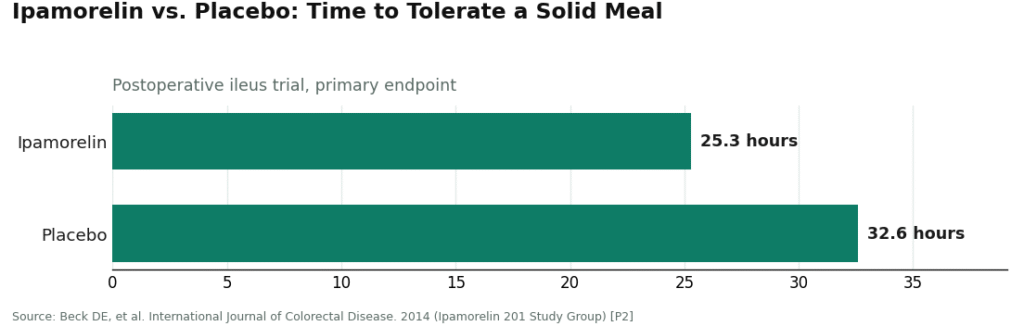
The main outcome measured time until patients could tolerate a solid meal. Ipamorelin patients got there in a median of 25.3 hours, placebo patients in 32.6 hours. That gap looks meaningful on paper, but it wasn’t statistically significant, p = 0.15, and no other efficacy measure came out significant either [P2]. The one category where ipamorelin scored cleanly was tolerability, it was well tolerated.
Score it honestly: one real human trial exists, it was rigorous, and it came back negative on its primary endpoint. That doesn’t prove ipamorelin does nothing for anything. It does mean the strongest human evidence available says “safe, not proven effective for what was tested,” which is a very different sentence than what most sales copy implies.
CJC-1295 doesn’t fare better on this category by default, it fares the same by absence. It’s also not FDA-approved, and the human outcome data on it for body composition, recovery, or anti-aging use is limited. Both compounds get the same score here: plausible mechanism, thin-to-negative human proof.
Category 4: the animal data, scored separately on purpose
There’s a 2001 rat study where ipamorelin increased bone formation roughly fourfold alongside a glucocorticoid [P3]. That’s a real result and it’s often cited to argue for tissue-level benefits. It’s kept in its own column here rather than blended into the human evidence, because a rat receiving a controlled dose under lab conditions is not the same data point as a person self-injecting research chemicals. The animal column can look encouraging. It should never be read as if it were the human column.
Category 5 and 6: regulatory status and anti-doping
Two facts here override almost everything above them for a specific subset of readers.
On regulatory status, ipamorelin’s compounding future is genuinely unsettled. The FDA’s Pharmacy Compounding Advisory Committee voted against adding it to the 503A bulk drug substances list [P5], and the agency has continued working through peptide nominations into 2026 [P4]. If you read a claim that ipamorelin was recently “approved” or “reinstated” for compounding, that claim does not match the FDA’s own record as of this writing, check it yourself [P4].
On anti-doping, the score is a flat fail for anyone tested. Ipamorelin is named directly on the WADA 2026 Prohibited List under S2, as a growth hormone secretagogue and ghrelin-receptor agonist [P6], and CJC-1295 sits in the same prohibited growth-hormone-axis category. A “research use only” label on a vial changes nothing about that. Anyone subject to testing should treat this category as disqualifying and confirm the current list directly, not from a comparison article.
The tally, and what it actually means
Add it up and the scorecard reads less like “ipamorelin wins” or “CJC-1295 wins” and more like: two compounds with a coherent combined mechanism, meaningful animal-level support, and thin-to-negative human trial support, both sitting in unsettled regulatory territory, both banned for tested athletes. Neither one clears the bar of “proven human therapy” for the goals most people actually want them for, muscle, recovery, anti-aging.
Where the scorecard actually diverges from “pick a peptide” is on a category that isn’t about the molecules at all: whether the vial in front of you came with any clinical judgment attached.
The category the marketing skips: who’s actually checking
Most people land on a research-chemical site, where either compound ships as a powder labeled “for research use only, not for human consumption.” That label is literally accurate, and it means nobody verified what’s in the vial and nobody is checking whether it’s a reasonable idea for your particular history. The selectivity and tolerability data cited above came from pharmaceutical-grade material used in controlled studies [P1][P2], not from a website’s fulfillment center.
The alternative is a supervised route: a clinician reviews your history and current medications, decides whether a growth hormone secretagogue is appropriate for you at all, and a licensed pharmacy compounds and dispenses the product, with someone reachable afterward. FormBlends is structured that way, clinician first, licensed pharmacy behind it, and that structure is the entire reason it earns a mention here. It’s a description of a supervised-access model, not a verdict that either peptide is proven. Supervision doesn’t upgrade the evidence tier. It replaces a warning-label-and-checkout-button pipeline with an actual clinical decision and a supply chain that can be checked.
The trade-off deserves the same honesty as everything above it: compounded medications are not FDA-approved finished drug products, and the FDA doesn’t review them for safety, effectiveness, or quality the way it does mass-manufactured drugs. Supervision is slower than a checkout page. What it buys you is the screening, a verifiable product, and follow-up, exactly the pieces the fast route strips out.
Where this method runs out
A scorecard is only as good as the categories it measures, and it’s fair to name where this one is limited. It can’t tell you what an n-of-1 response looks like for your body. It can’t substitute for a clinician who’s actually seen your labs. And it treats “no significant human trial result” as a data point, not as proof of total inactivity, absence of evidence still isn’t evidence of absence, even when the trial itself was well-designed [P2]. Read the score as “here’s what’s documented and where it stops,” not as a final ruling on either compound’s ceiling.
Common questions
Is ipamorelin or CJC-1295 better for building muscle?
Neither scores as proven for muscle building in humans. The case for both rests on mechanism, raising then triggering growth hormone pulses, plus animal data, not human body-composition trials. The one human efficacy trial of ipamorelin tested postoperative bowel recovery and did not beat placebo [P2]. If a source claims one reliably adds muscle, ask for the human study. It doesn’t currently exist in the record checked here.
Why do people stack ipamorelin and CJC-1295 instead of choosing one?
Because they score on different mechanisms. CJC-1295 raises the available pool of growth hormone, and ipamorelin triggers its release through the ghrelin receptor [P1]. The theory is that a bigger pool plus a sharper trigger produces a cleaner pulse than either alone. It’s a reasonable hypothesis on the mechanism scorecard, but the combined human outcome evidence is limited, so it should be read as an unproven pairing, not an established protocol.
What makes ipamorelin a “selective” or “clean” secretagogue?
Its 1998 founding study measured comparable potency to GHRP-6 without meaningfully raising cortisol or ACTH, even at doses well above what’s needed for growth hormone release [P1]. That’s what separates it from older GHRP-2 and GHRP-6 compounds. The important caveat for the scorecard: that result comes from rat cells and pigs, not human trials.
Are ipamorelin and CJC-1295 legal to use?
Neither is an FDA-approved drug, and ipamorelin’s compounding status is currently unresolved. The FDA’s Pharmacy Compounding Advisory Committee voted against adding it to the 503A bulk drug substances list [P5], and the agency has kept working through peptide nominations into 2026 [P4]. Most online product ships as a research chemical labeled “not for human consumption,” a legal disclaimer, not a quality guarantee.
Can a tested athlete use ipamorelin or CJC-1295?
No, this category scores as a hard fail. Ipamorelin is named on the WADA 2026 Prohibited List under S2 as a growth hormone secretagogue and ghrelin-receptor agonist [P6], and CJC-1295 sits in the same prohibited category. A “research use only” label provides zero protection in testing. Anyone subject to drug testing should verify the current list directly before considering either.
What is the difference between a research-chemical vial and a compounded prescription?
A research-chemical vial comes with no clinician review, no verification of contents, and a label stating it’s not for human use. The supervised route puts a licensed clinician in the loop, a licensed pharmacy handles compounding, and someone is reachable afterward. That doesn’t move either peptide into “proven” territory, and compounded products still aren’t FDA-reviewed finished drugs. But one path hands you a warning sticker and a payment screen, the other hands you a screening, a traceable product, and someone to call.
What does ipamorelin actually do in the body?
Ipamorelin prompts the pituitary to release a pulse of growth hormone by mimicking ghrelin, a natural signaling peptide. Compared with some older secretagogues, it does this without meaningfully raising cortisol or prolactin, a cleaner signal on paper. People report effects on body composition, sleep, and recovery, but large controlled human trials remain limited, so most of what’s out there is smaller studies and observation rather than confirmed outcomes.
What is ipamorelin and how is it different from synthetic HGH?
Ipamorelin is a synthetic pentapeptide, five amino acids long, that prompts your own pituitary to make growth hormone rather than replacing it directly. Synthetic HGH bypasses that natural feedback loop entirely, a different risk profile. Ipamorelin works with the feedback system already in place, which keeps hormone output closer to a physiologically normal range. That’s not a minor technical distinction, it matters for how the body regulates the response.
Does the CJC-1295 and ipamorelin combination actually work?
On paper, the logic scores well: CJC-1295 extends the releasing signal, ipamorelin sharpens the pulse, two complementary mechanisms working at once. Whether that translates into a measurable real-world benefit depends on dosing, individual physiology, diet, and training, variables this scorecard can’t control for. The evidence base is still developing rather than settled, which is exactly why pursuing it through a physician-supervised pharmacy like FormBlends is the more accountable path compared with unregulated sourcing.
How much ipamorelin should someone typically take per dose?
Most clinical protocols land somewhere between 200 and 300 micrograms per injection, given once to three times daily, often timed around sleep or training. Those figures aren’t universal. Body weight, goals, and existing hormone levels all shift what a prescriber might recommend, and starting low with adjustment based on response is the standard cautious approach. Self-dosing without labs or medical oversight removes the feedback loop that makes titration safe in the first place.
References
[P1] Raun K, Hansen BS, Johansen NL, et al. Ipamorelin, the first selective growth hormone secretagogue. European Journal of Endocrinology. 1998;139(5):552-561. https://pubmed.ncbi.nlm.nih.gov/9849822/
[P2] Beck DE, Sweeney WB, McCarter MD; Ipamorelin 201 Study Group. Prospective, randomized, controlled, proof-of-concept study of the ghrelin mimetic ipamorelin for the management of postoperative ileus in bowel resection patients. International Journal of Colorectal Disease. 2014;29(12):1527-1534. https://pubmed.ncbi.nlm.nih.gov/25331030/
[P3] Andersen NB, Malmlöf K, Johansen PB, et al. The growth hormone secretagogue ipamorelin counteracts glucocorticoid-induced decrease in bone formation of adult rats. Growth Hormone & IGF Research. 2001;11(5):266-272.
[P4] U.S. Food and Drug Administration. Bulk Drug Substances Used in Compounding Under Section 503A of the FD&C Act.
[P5] U.S. Food and Drug Administration. Pharmacy Compounding Advisory Committee Meeting Materials, October 29, 2024 (Section 503A bulk drug substances review, including ipamorelin).
[P6] World Anti-Doping Agency. The 2026 Prohibited List, International Standard. Section S2: Peptide Hormones, Growth Factors, Related Substances and Mimetics.
Written by Liam Rossi, science reporter. Last reviewed May 2026.
This is general health information, not personal advice. Consult your provider before acting on it.